


The Fungi
These are not ingredients. They are organisms.
Long before supplements existed, these fungi were already solving problems humans had not yet named. They built communication networks beneath forests, developed biochemical intelligence across hundreds of millions of years, and outlived every mass extinction on record. We did not create these compounds. We just finally paid attention.
Each mushroom in our lineup has a distinct purpose, a distinct personality, and a story worth knowing. This is where you meet them.
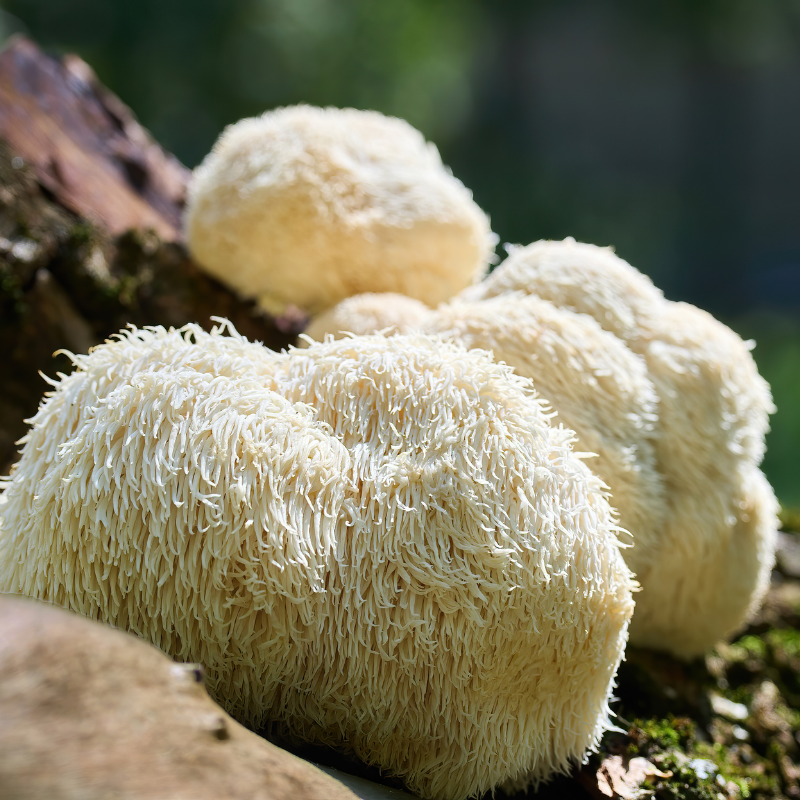
Cognitive Support
Lion's Mane
"The one that makes you wonder why thinking ever felt hard."
Lion's Mane is the only mushroom known to stimulate Nerve Growth Factor, the protein your neurons need to grow, repair, and survive. It does not just support your brain. It tells your brain to rebuild.
Used for centuries in traditional Chinese medicine, studied in modern neuroscience for memory, focus, and neurological resilience. The science is catching up to what practitioners knew generations ago.
It grows in cascading white tendrils that look nothing like a fungus. Nature's way of reminding you that the most powerful things rarely look the part.
What it feels like:
Two hours pass and you did not notice. No buzz, no push, no crash. Just your brain, finally operating the way it was always supposed to.
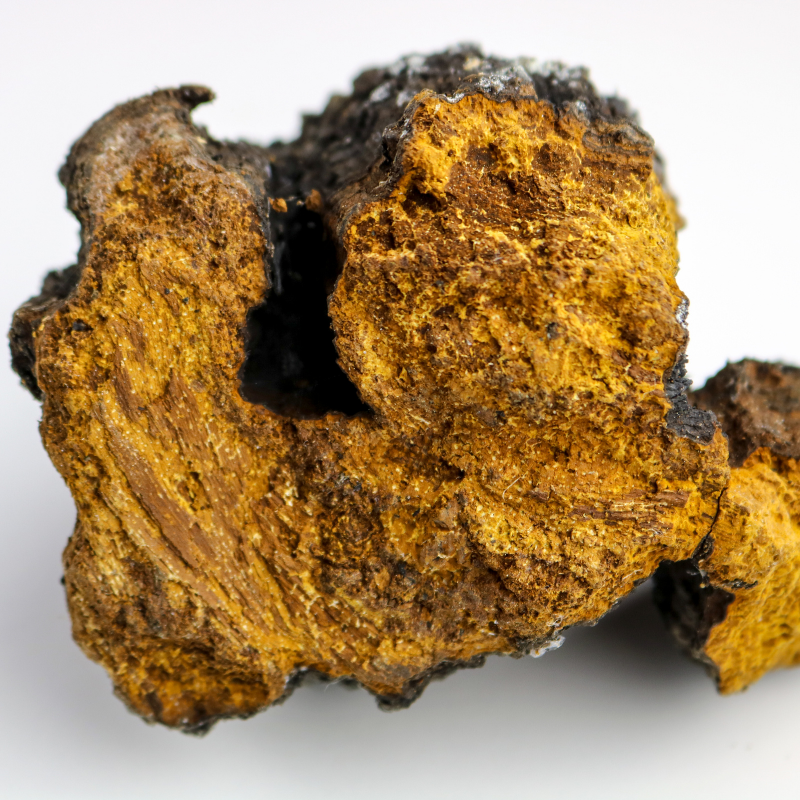
Immune Defense
Chaga
"Survived Siberian winters for centuries. Your immune system just found its backup."
Chaga does not look like a mushroom. It looks like charred wood fused to a birch tree, which is essentially what it is. It grows slowly, over years, pulling nutrients from the tree and concentrating them into one of the most antioxidant-dense substances found in nature.
Siberian shamans called it the Gift from God. Norwegian and Finnish traditions brewed it as a daily tea. Modern research points to its beta-glucan content, its betulinic acid compounds, and an ORAC antioxidant score that makes blueberries look ordinary.
Chaga does not announce itself. It just works, at the cellular level, the way the best protection always does.
What it feels like:
The season where everyone around you gets sick, and you don't. A baseline of strength that quietly becomes your new normal.
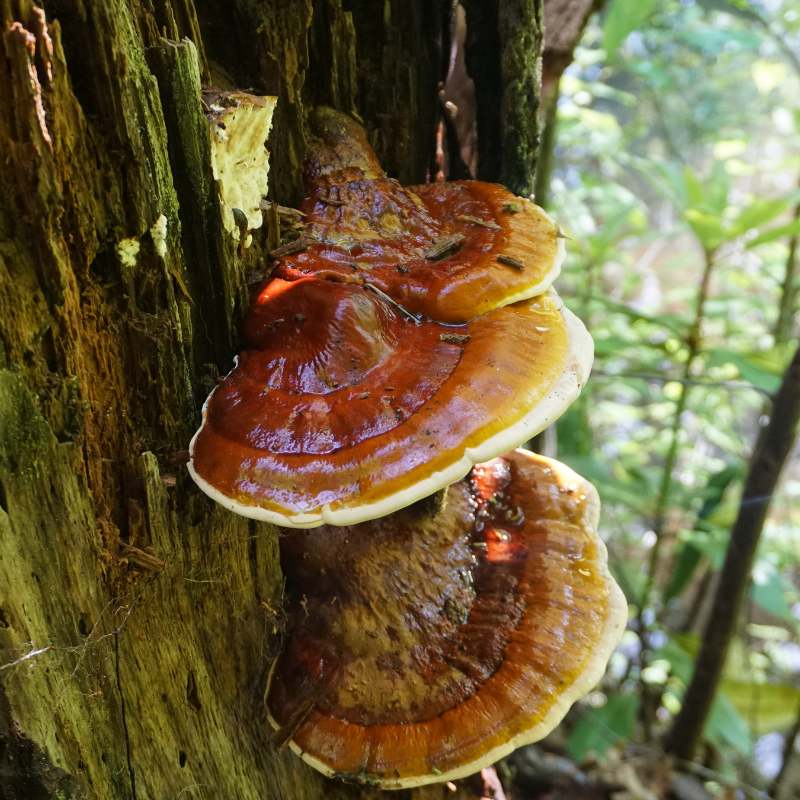
Calm & Recovery
Reishi
"When the world gets too loud, this is what quiet feels like."
Reishi has been called the Mushroom of Immortality in Chinese culture for over 2,000 years. It was so rare it was reserved exclusively for emperors. Today we grow it with care and make it available to everyone, because calm should never be a luxury.
Its triterpenes and beta-glucans have been studied for cortisol regulation, adaptogenic properties, and deeper, more restorative sleep. Reishi does not sedate you. It recalibrates you. It helps your body remember what rest actually feels like.
The glossy, lacquered cap looks almost artificial, too perfect, too symmetrical. Nature signaling that something extraordinary is happening inside.
What it feels like:
Your shoulders drop. The exhale you did not know you were holding. Sleep that actually feels like sleep. A nervous system that has finally been given permission to rest.
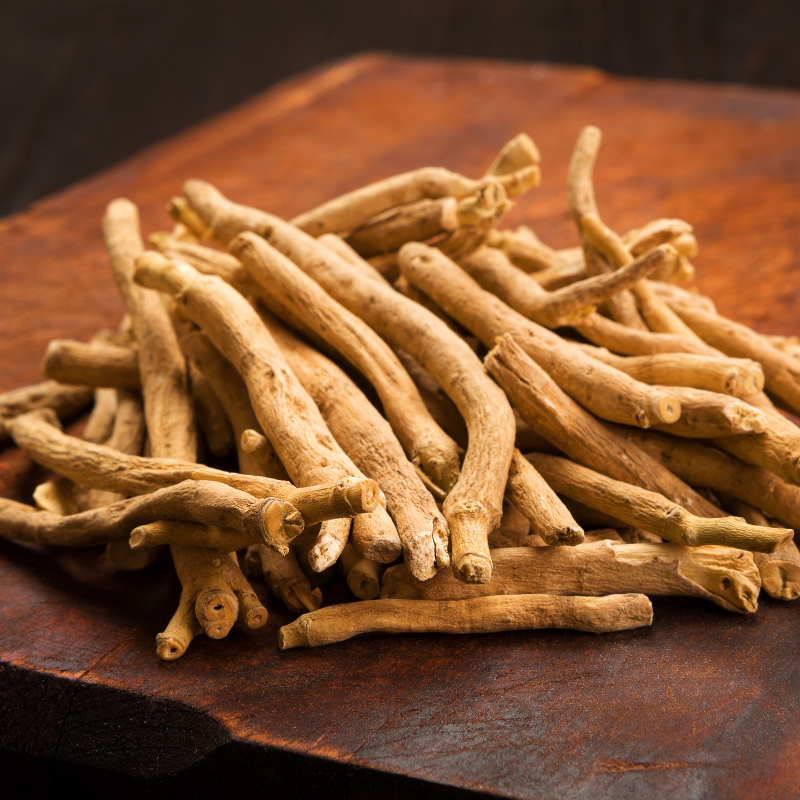
Stress Adaptation
Ashwagandha
"Cortisol has been running the show long enough."
Technically a root, not a mushroom. But its role in our formulas is too important to leave out of this conversation.
An Ayurvedic staple for over 3,000 years, Ashwagandha is one of the most clinically studied adaptogens on the planet. Multiple double-blind, placebo-controlled trials show it significantly reduces serum cortisol, improves stress resilience, supports thyroid function, and enhances physical endurance.
Stress is the silent variable that undermines everything else. You can take the best mushrooms in the world, but if your cortisol is chronically elevated, the signal gets lost. Ashwagandha clears the channel.
What it feels like:
Weeks in, you realise things that used to derail you simply don't anymore. Not numbness. Not detachment. Just a steadiness that was always available, waiting for the right support.
Energy & Performance
Cordyceps
"Energy that does not ask permission."
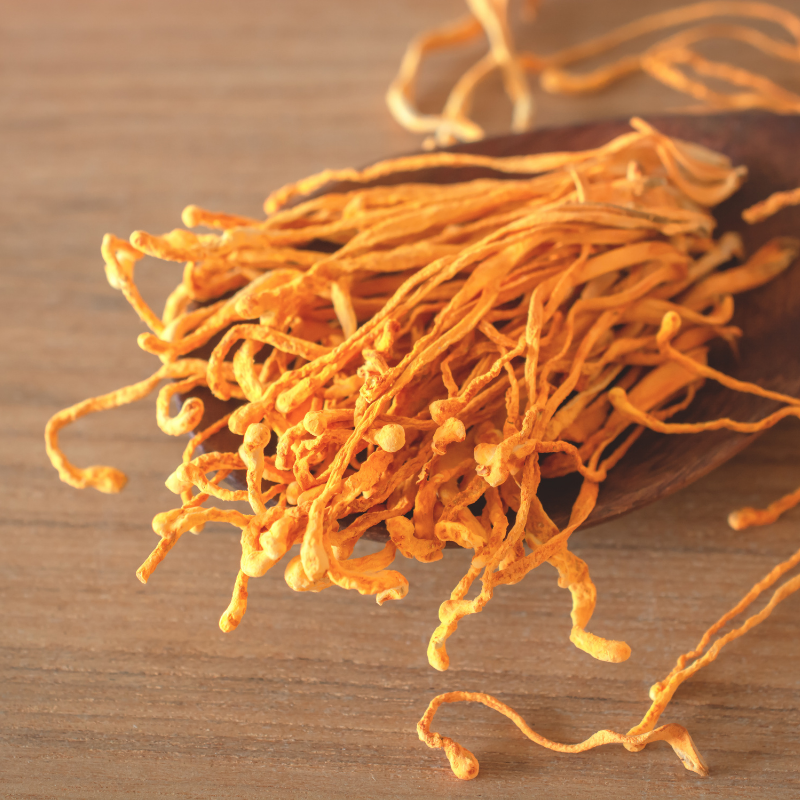
Cordyceps has one of the most dramatic origin stories in nature. In the wild, it parasitizes insects, taking over their biology to complete its own life cycle. We grow ours on a plant-based substrate, but the compounds are identical: cordycepin and adenosine, working directly at the mitochondrial level.
Tibetan herders first noticed their yaks had extraordinary endurance after grazing on Cordyceps-rich pastures at altitude. Modern sports science has studied it for VO2 max, ATP synthesis, and oxygen utilization. The fundamental mechanics of how your body generates and sustains energy.
No spike. No crash. No dependency. Just a system operating at its actual capacity, which turns out to be considerably higher than most people ever find out.
What it feels like:
More left in the tank at the end of your workout than you expected. Afternoon energy that does not need caffeine. A body that has remembered it was built to move.
THE INTELLIGENCE
The mycelium network is the original internet.
Beneath every forest floor, fungi built a communication network of extraordinary complexity before humans had language to describe it. Trees share nutrients through it. Plants signal distress across it. Entire ecosystems coordinate through it in real time, without a server, without a signal, without ever going down.
Scientists call it the Wood Wide Web. We call it proof that intelligence does not require a brain. It requires connection, time, and the right conditions.
At a moment when artificial intelligence is reshaping how we think about cognition, fungi solved distributed intelligence 500 million years ago. The compounds they developed along the way, the beta-glucans, the triterpenes, the hericenones, are the biochemical record of that intelligence. And they are in every capsule we make.

Watch
Watch the network think.
Mycelium time-lapse documentary footage — the most intelligent network on the planet, in motion.
You have read the science.
Now feel the difference.
Start with the one that speaks to you. Or start with all ten.
Either way, your biology already knows what it needs.